

Enhanced 3D vision
Improved detail, colour and depth perception support the surgeon’s view of the tissues.
Sources checked • October 2026
Understand technology names and questions to discuss with your clinician. Official sources were checked on 2 October 2026. A device name or approval in one country does not establish availability for every case or hospital.
Sources last reviewed: 2 October 2026 · Blue Crescent
New: da Vinci 5 technology
An Intuitive surgical system that helps a surgeon perform selected operations through small incisions. The surgeon controls the instruments from a console throughout the operation; the robot does not operate on its own.
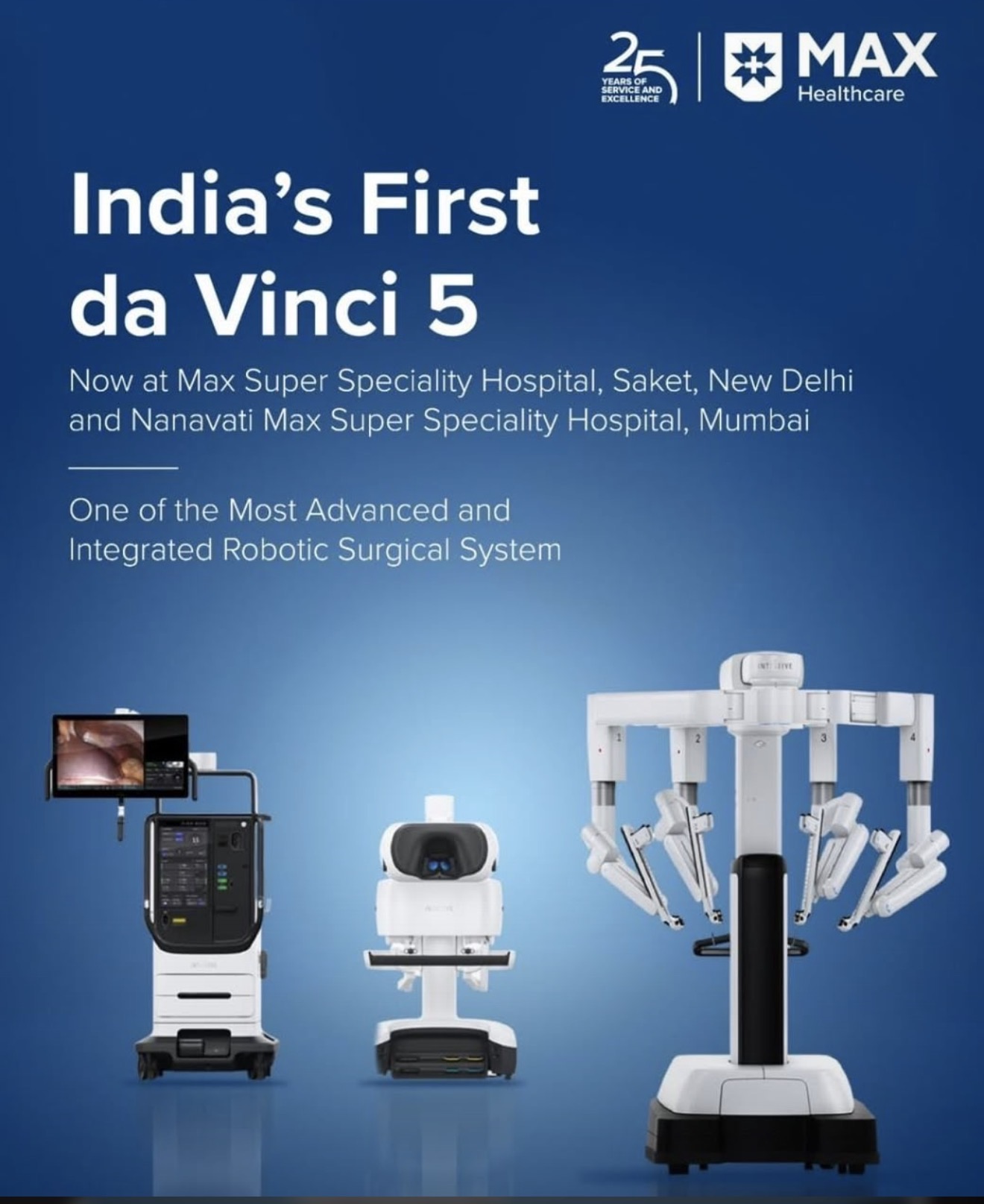
Improved detail, colour and depth perception support the surgeon’s view of the tissues.
Compatible instruments convey push and pull sensations to help the surgeon judge tissue interaction.
A more adjustable console integrates operating-room functions, with tools for training and performance review.
da Vinci 5 is a different generation from Xi, with changes to vision and the console and Force Feedback on compatible instruments. A hospital with Xi does not necessarily have 5. The generation name alone does not establish a better result for your case.
A specialist may consider selected urological, general, gynaecological and thoracic operations. Actual use depends on local authorisation, branch equipment, surgeon experience and individual assessment.
The aim is to support minimally invasive surgery and instrument control. These features do not guarantee less pain, earlier discharge or better cancer outcomes. Published Force Feedback evidence includes preclinical studies; it does not establish a particular reduction in patient complications. Bleeding, infection, tissue injury and anaesthetic risks remain possible.
These examples are grounded in official sources. A technology is not suitable for everyone or available at every branch; we confirm the centre, clinician and eligibility before coordination.
Enhanced 3D vision and Force Feedback with compatible instruments, controlled by the surgeon. Explore potential benefits, limitations and availability.
Read the explanation and benefitsSurgeon-controlled systems; Artemis describes Da Vinci Xi. Suitability is discussed after individual assessment.
SourceRadiation technology for selected tumours, described by Medanta. Its name does not imply a scalpel or surgical incision.
SourceApollo Delhi describes ZAP-X for focused radiation in selected brain tumours and neurological conditions.
SourceIIT Bombay confirms Indian approval of NexCAR19 for relapsed or refractory B-cell lymphomas and leukaemia.
SourceMedanta describes catheter-based aortic valve replacement for selected severe aortic stenosis cases, assessed by the cardiac team.
SourceGene and protein tests can inform treatment options, according to the US National Cancer Institute.
SourceBLK-Max announces robotic joint replacement systems. The orthopedic assessment determines the procedure and system.
SourceMax describes TrueBeam and stereotactic radiotherapy. The appropriate system and branch are confirmed before coordination.
SourceThe following updates concern US FDA decisions. They are informational; availability and approval in India, and patient eligibility, require separate confirmation from the treating centre.
On 17 June 2026, FDA expanded TECELRA to patients aged 12 and older with specified previously treated synovial sarcoma and HLA/MAGE-A4 criteria.
SourceOn 24 September 2026, FDA approved belzutifan with lenvatinib for adults with advanced clear-cell-component renal cell carcinoma after a PD-1 or PD-L1 inhibitor.
SourceWhat is the treatment goal in my case? Why this technology and what are the alternatives? What risks should I understand? Which tests are required? What stay and follow-up are expected? What does the quote cover? Ask for case-specific written answers rather than a general success percentage.
Yes, these technologies are published by partner hospitals in Delhi and Gurgaon (such as Medanta, Apollo, Artemis, Fortis and BLK-Max). Suitability is confirmed by the specialist after reviewing your reports.
Yes, our hospital contracts provide 10% off surgical operation costs, 50% off prescribed oncology medicines, and 20% off general medicines, with free coordination and translation.
Understand what changed in treatment and distinguish regulatory approval from experimental research before planning travel.
Explore verified updates